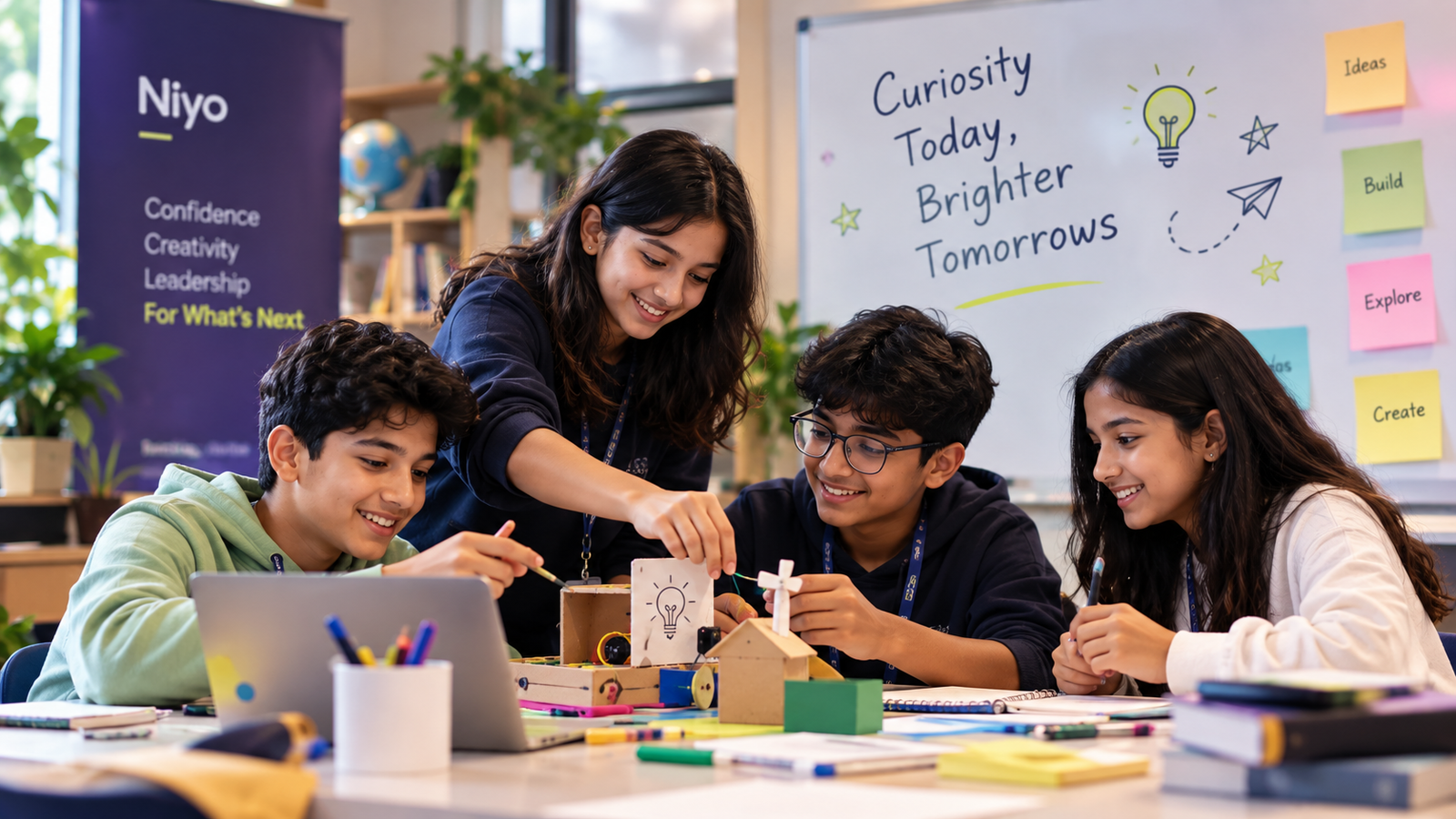

Future-ready learning for students in Classes 6–12

Beyond school. Built for the future.

Niyo helps students move beyond textbook learning to build confidence, creativity, leadership and real-world skills through practical experiences designed for the years that shape who they become.

Classes 6–12
Scholarship Opportunities
Skills + Personality
The Niyo Journey Classes 6–12

One journey.
Three stages.

01
Niyo Explorer Classes 6–7
02
Niyo Innovator Classes 8–10
03
Niyo Fellowship Classes 11–12
Designed for Classes 6–12

Growth that evolves with every stage.

Opportunity Perform. Grow. Compete for scholarships.
Students Build
Confidence Creativity Leadership
Guided feedback Projects + reflection
The Niyo Experience

More than learning. Skills for life.

Niyo combines practical learning, guided experiences and meaningful opportunities to help students become confident, capable and future-ready.

01
C
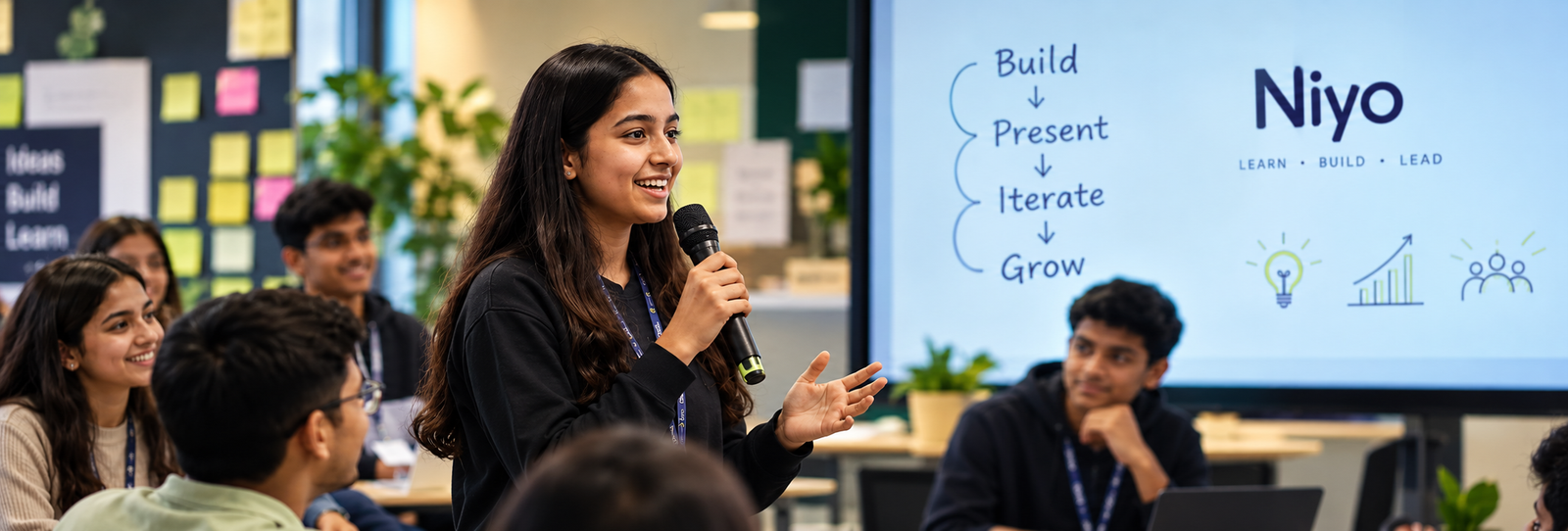
Speak

Confidence &
Communication

Students learn to express ideas clearly, present confidently and build a stronger sense of self.
02
✦
Create

Creativity &
Innovation

Practical projects help students identify problems, generate ideas and turn imagination into solutions.

03
L
Lead

Leadership &
Collaboration

Students learn teamwork, ownership, decision-making and how to lead with initiative and empathy.

04
↗
Explore

Real-world
Exposure

Experiences beyond the classroom help students understand possibilities, careers and the world around them.

05
★
Grow

Scholarships &
Opportunities

Students can earn recognition and may qualify for opportunities that encourage them to keep building and aiming higher.

Students participating in a Niyo future-skills learning experience
The Niyo Learning Journey

From exploration to leadership.

A structured learning journey for students from Classes 6–12, designed to build confidence, creativity, leadership and real-world readiness at every stage.

Classes 6–12 Progressive Learning Skills + Opportunities
Explore Programs
1 Stage-based growth

A journey that grows with the student

Niyo Explorer, Innovator and Fellowship are designed around different stages of a student’s development, so the learning evolves as they grow.

2 Learn by doing

Projects instead of passive learning

Students work on practical challenges, presentations, team activities and creative projects that turn learning into real experience.

3 Guided feedback

Mentorship throughout the journey

Students receive structured guidance, feedback and encouragement that helps them understand their strengths, improve and make better decisions.

4 Beyond the classroom

Real-world exposure and experiences

Interaction with ideas, professionals, communities and real situations helps students understand where their skills can take them.

5 Grow together

A high-energy peer learning community

Students learn alongside ambitious peers, collaborate in teams and build friendships through shared challenges, projects and experiences.

6 Recognition

Scholarships and future opportunities

Strong participation and performance can open access to recognition, scholarships and opportunities that encourage students to keep progressing.

The Niyo Path

One journey. Three stages of growth.

Niyo grows with the student. Each stage is designed around their age, curiosity and readiness — moving from exploration, to innovation, and finally to leadership and real-world impact.

01 Explore
02 Innovate
03 Lead
Niyo Explorer students learning through creative activities
01
Classes 6–7
Discover • Express • Explore

Niyo Explorer

Who is it for? Students beginning to discover their interests, personality and confidence beyond academics.

What students gain

  • Confidence and self-expression
  • Communication and teamwork
  • Creativity and curiosity
  • Early real-world exposure
Know More
Niyo Fellows presenting and developing leadership skills
03
Classes 11–12
Lead • Create • Impact

Niyo Fellowship

Who is it for? Senior-school students ready to take ownership, build leadership skills and prepare for life beyond school.

What students gain

  • Leadership and independent thinking
  • Real-world projects and mentorship
  • Future and career readiness
  • Scholarships and opportunities
Know More
01

Growth
Scholarship

For students who demonstrate exceptional personal development during the Niyo journey — especially in confidence, communication, independence and willingness to improve.

Growth • Reflection • Improvement
02

Learning Excellence Scholarship

For students who consistently demonstrate strong understanding, thoughtful mission work, curiosity, research quality and disciplined participation throughout the program.

Learning • Quality • Consistency
03

Innovation
Scholarship

For students whose project demonstrates originality, strong problem-solving, creativity, thoughtful experimentation and meaningful improvement through feedback or testing.

Ideas • Execution • Evidence
04

Leadership
Scholarship

For students who show initiative, teamwork, responsibility, communication and the ability to positively influence or support others during collaborative work.

Initiative • Teamwork • Responsibility
05

Consistency
Scholarship

For students who maintain strong participation, complete missions responsibly, respond to feedback and demonstrate sustained effort across the full learning journey.

Discipline • Effort • Commitment
How Students Are Selected

A transparent, multi-stage selection process.

Scholarships should reflect genuine learning and performance. Niyo therefore considers evidence created across the entire program instead of relying on a single examination or interview.

01
Eligibility

Program completion review

Students must complete the required learning phase, missions, portfolio elements and final project submission for their program.

02
Evaluation

Rubric-based scoring

Projects and portfolios are evaluated using published criteria such as understanding, originality, execution, evidence, improvement, impact and communication.

03
Shortlisting

High-performing students shortlisted

Students demonstrating strong overall performance or exceptional strength in a scholarship category can move into the finalist pool.

04
Final Showcase

Expo presentation & Q&A

Where applicable, finalists present their work, explain their decisions, demonstrate evidence and respond to questions from the evaluation panel.

05
Award

Final scholarship decision

Final recipients are selected based on the relevant scholarship category, evidence across the journey, rubric scores and final jury review where applicable.

What We Look For

Selection goes beyond marks.

Learning Understanding, research and quality of thinking
Growth Improvement, reflection and response to feedback
Execution Ability to turn ideas into completed work
Originality Creativity, insight and independent thinking
Evidence Research, testing, results or demonstrated learning
Communication Clarity, presentation and ability to explain decisions
Niyo Explorer student
Niyo Explorer Student
Confidence

“I used to have ideas but would hesitate to speak when everyone was listening. The weekly speaking activities helped me organise what I wanted to say and made presenting feel much less scary.”

Parent of a Niyo Explorer student
Niyo Explorer Parent
Independence

“The change we noticed was not about marks. Our child started planning small responsibilities independently, asking better questions and explaining opinions instead of giving one-word answers.”

Niyo Innovator student working on a project
Niyo Innovator Student
Problem Solving

“My first project idea sounded good, but testing it showed several problems. I learned that changing an idea after feedback does not mean it failed — it means the project is getting better.”

Parent of a Niyo Innovator student
Niyo Innovator Parent
Thinking

“We noticed our child becoming less interested in simply being told the answer. There was more questioning, comparing information and trying to explain why one solution might work better than another.”

Niyo Fellow presenting a capstone
Niyo Fellowship Student
Leadership

“I thought leadership meant being the person with the best ideas. During Fellowship I realised that it also means listening, setting expectations, handling disagreement and taking responsibility for the result.”

Parent of a Niyo Fellowship student
Niyo Fellowship Parent
Future Readiness

“What stood out was the maturity in conversations about college, money, projects and future choices. Instead of only asking us what to do next, our child started researching options and coming to us with informed questions.”

01

What exactly is Niyo?

Niyo is a future-readiness learning journey for students from Classes 6–12. Instead of focusing only on academic subjects, Niyo helps students develop confidence, communication, critical thinking, creativity, leadership, digital intelligence, independence and real-world execution.

Students learn through structured lessons, practical weekly missions, projects, reflection and presentation rather than only lectures.

02

Which Niyo program is right for my child?

Niyo is divided into three stages so that the learning matches the student's age and developmental stage.

Niyo Explorer Classes 6–7

Focuses on curiosity, confidence, communication, creativity and independence.

Niyo Innovator Classes 8–10

Focuses on critical thinking, innovation, projects, collaboration and problem solving.

Niyo Fellowship Classes 11–12

Focuses on leadership, money, AI, business, decision-making and preparation for life beyond school.

03

How long is the Niyo learning journey?

Each Niyo program follows a structured six-month journey.

Phase 01 Weeks 1–12

Structured learning with one practical mission every week.

→
Phase 02 Weeks 13–24

A guided project or capstone where students research, create, test and improve their work.

04

What are the weekly missions?

Weekly missions turn learning into action. Instead of simply watching or listening to a lesson, students complete a practical task connected to the skill being taught.

Depending on the program, this could include recording a short presentation, interviewing someone, investigating information, leading a small activity, creating a prototype, conducting research or completing a real-world responsibility.

05

Is Niyo another academic coaching program?

No. Niyo does not replace school academics and is not designed as tuition for school subjects or examination preparation.

The focus is on capabilities that students often need beyond academics — communication, confidence, critical thinking, creativity, digital awareness, teamwork, leadership, decision-making and real-world execution.

06

What happens during the project phase?

After the first 12 weeks, students move into a guided project phase where they apply what they have learned.

The exact project journey becomes more advanced at each level, but typically includes research, planning, creation, testing, feedback, improvement and final presentation.

The goal is not simply to produce something impressive. Students are expected to understand what they did, what did not work and how their thinking improved.

07

How are students evaluated?

Niyo is designed around evidence of learning rather than another marks-based examination.

Understanding Creativity Execution Evidence Improvement Communication

The exact evaluation criteria vary by program because Explorer, Innovator and Fellowship students are working at different levels of complexity.

08

How do Niyo scholarships work?

Niyo scholarships are intended to recognise students who demonstrate meaningful learning, effort, growth, strong project work, leadership or outstanding final performance.

Scholarships are competitive and are not automatically awarded simply because a student joins or completes the program.

Scholarship categories, eligibility, amounts, number of recipients and timelines can vary by cohort and should be announced separately for each scholarship cycle.

09

What is the Niyo Expo?

The Niyo Expo is a showcase opportunity for selected students whose projects demonstrate strong learning, execution or potential.

Depending on the program, selected participants may present their project, explain their process, demonstrate evidence and respond to questions from an evaluation panel.

The Expo is designed to celebrate thinking, effort, improvement and execution rather than simply expensive or visually polished projects.

10

Does a student need to be academically outstanding to join?

Niyo is designed around growth, participation, curiosity and practical capability — not only academic performance.

A student does not need to already be an excellent speaker, leader or innovator. Developing those capabilities is part of the purpose of the program.

11

How is AI used in Niyo?

Niyo introduces AI progressively and responsibly. Students learn that AI can support research, creativity and productivity, but its answers should not automatically be treated as correct.

Topics may include prompting, verification, hallucinations, privacy, plagiarism, deepfakes, digital reputation, ethics and the importance of human judgement.

12

What will parents actually be able to see?

Because Niyo includes weekly missions, project work, presentations, reflection and a student portfolio, progress can be seen through actual work rather than only a completion certificate.

Examples may include recorded presentations, research notes, project drafts, prototypes, reflections, feedback records and final project submissions.

Start the Niyo Journey

School builds knowledge. Niyo builds what comes next.

Give your child a structured space to build confidence, think independently, create, communicate and develop skills that matter beyond exams.

Classes 6–12 Stage-based learning
6-Month Journey Learn + build + present
Real Outcomes Portfolio + project evidence